Brain · Movement Disorders
Deep Brain Stimulation (DBS) in Faridabad
For some people with Parkinson's disease, tremor or dystonia, medicines no longer give steady control. DBS is a carefully selected option that works alongside neurology care, not instead of it.
DBS में दिमाग के खास हिस्से में पतले तार लगाकर एक छोटे उपकरण से हल्के विद्युत संकेत दिए जाते हैं। यह कुछ चुने हुए पार्किंसंस, कंपन (ट्रेमर) और डिस्टोनिया के मरीज़ों में लक्षण कम करने में मदद कर सकता है।
Understanding Deep Brain Stimulation
Deep brain stimulation places very thin electrodes in precise targets deep in the brain. They connect, under the skin, to a small battery-powered pulse generator in the chest, rather like a cardiac pacemaker. Gentle electrical pulses adjust abnormal signals in the circuits that control movement. Nothing is removed from the brain, and settings can be changed after surgery.
DBS is mainly used for Parkinson's disease, essential tremor and dystonia. In Parkinson's, it is usually considered when medicines still work but wear off between doses, or when extra uncontrolled movements called dyskinesias appear. Our article on surgical options in Parkinson's gives more background.
Deep Brain Stimulation is listed among Dr. Naresh Panwar's specialisations, together with Parkinson's disease surgery, at Sarvodaya Hospital, Faridabad. Choosing the right patient is the most important step and is done jointly with a movement-disorder neurologist. DBS manages symptoms; it does not halt the underlying disease.
Common symptoms
Symptoms vary from person to person. Having one of these does not mean you have this condition.
Stiffness, slowness or freezing return before the next levodopa dose is due.
Involuntary twisting or jerking movements, often when medicine levels peak.
Hand shaking that makes eating, writing or drinking difficult despite medicines.
Sustained muscle contractions twisting the neck, limbs or trunk.
Nausea, hallucinations or low blood pressure that limit dose increases.
Swings between good and bad hours that disrupt work, social life and caregiving.
Possible causes & risk factors
Loss of dopamine-producing cells; people who still respond to levodopa are the usual DBS candidates.
A common, often inherited tremor of the hands, head or voice, distinct from Parkinson's.
Genetic or acquired conditions causing abnormal postures; some types respond to DBS.
Fluctuations usually appear after years of Parkinson's; age, memory and general health shape decisions.
When to seek help
Book a routine consultation
- Medicine effect wearing off before the next dose
- Tremor interfering with daily tasks despite treatment
- Your neurologist has mentioned DBS and you want a surgical opinion
- Dystonia not controlled by medicines or botulinum toxin
Seek emergency care
- Sudden weakness, confusion or speech difficulty — call 112 or go to the nearest emergency department
- High fever with severe stiffness after Parkinson's medicines are stopped suddenly
- A DBS patient with wound redness, discharge or fever
- A fall with head injury, especially in someone on blood thinners
How it is diagnosed
Movement is scored off and on medicine; a strong response often suggests DBS may help.
Confirms the diagnosis and excludes look-alike conditions that do not respond to DBS.
Used to plan targets and rule out other problems.
Significant dementia or untreated depression may make DBS unsuitable.
Available treatment options
Treatment is chosen after examining you and studying your scans. Many people do well without an operation.
A neurologist adjusts timing, doses and combinations — often the simplest way to smooth fluctuations.
Regular exercise, balance training, physiotherapy and voice therapy help at every stage.
Useful for focal dystonias such as neck dystonia.
Electrodes are placed in targets such as the subthalamic nucleus, globus pallidus or thalamus, depending on the condition, with a pulse generator under the chest skin.
When neurosurgery may be recommended
- Confirmed Parkinson's disease with good levodopa response
- Troublesome fluctuations or dyskinesias despite optimised medicines
- Disabling tremor not controlled by medicines
- No significant dementia or uncontrolled psychiatric illness
- Realistic expectations and family support for programming visits
Procedure overview
A simplified outline. The exact steps depend on your scans and the approach chosen.
- Candidacy assessmentNeurologist and neurosurgeon confirm DBS is appropriate.
- Target planningMRI, sometimes merged with CT, is used to calculate electrode paths.
- Electrode placementThin leads are inserted through small skull openings; some centres keep patients awake for testing.
- Generator implantationThe battery is placed below the collarbone and connected by a wire under the skin.
- ProgrammingStimulation is switched on and fine-tuned over several visits alongside medicines.
Potential benefits, risks & limitations
Potential benefits
- May reduce tremor, stiffness and slowness during off periods
- Often allows lower medicine doses, reducing dyskinesias
- Adjustable and reversible stimulation
Possible risks
- Bleeding in the brain causing stroke-like symptoms
- Device infection, sometimes needing removal
- Speech, balance or mood changes from stimulation, often adjustable
- Lead breakage or other hardware problems
- Future battery replacement surgery
DBS does not slow Parkinson's disease, and symptoms that do not respond to levodopa — such as balance problems and memory changes — usually do not improve. Medicines are usually still needed.
Recovery & follow-up
Most patients go home within days. Benefits typically unfold over weeks to months as programming progresses. A symptom diary helps with adjustments.
Carry your device card, tell doctors before MRI scans or procedures using electrical cautery, and keep regular programming reviews. Patients from Greater Faridabad, Palwal and Ballabhgarh should plan transport for these visits.
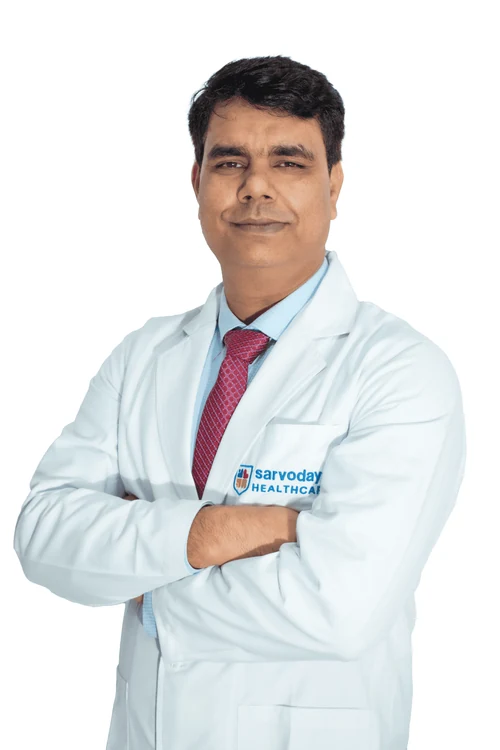
Why consult Dr. Naresh Panwar
- Deep Brain Stimulation (DBS) is one of the specialisations named on his official Sarvodaya Hospital profile
- Parkinson's disease surgery is also listed among the conditions he manages
- MCh in Neurosurgery (SMS Medical College, Jaipur) and previous work as Senior Consultant at Medanta Institute of Neurosciences, Lucknow
- Member of the Neurological Society of India (NSI)
Questions to ask your surgeon
Write these down and bring them to your appointment.
- Am I a suitable candidate based on my levodopa response?
- Which brain target do you recommend for me, and why?
- Will I be awake for any part of the surgery?
- Who will programme the device, and how often?
- Which of my symptoms are unlikely to improve?
Frequently asked questions
Is DBS a last-resort operation?
Not necessarily. Because good levodopa response predicts benefit, it is often considered while medicines still work. Read when DBS is considered for more.
Kya Parkinson ka operation se rog khatam ho jata hai?
Nahi. DBS Parkinson ko khatam nahi karta, lekin kuch chune hue mareezon mein kampan, akdan aur dawa ke utaar-chadhaav kam kar sakta hai. Dawaiyan aam taur par chalti rehti hain.
Does DBS help essential tremor?
Many people with disabling hand tremor improve with stimulation of the thalamus. The decision follows a neurology assessment.
Can I have an MRI after DBS?
Some MRI scans are possible under specific conditions depending on the device. Always tell the imaging centre and check with your team first.
We live in NIT Faridabad. How do we begin?
Bring your neurologist's notes, medicine chart and, if possible, phone videos of on and off states to a consultation at Sarvodaya Hospital, Sector 8, Faridabad. Call +91 96608 88640 to confirm timings.
Related care & reading
Appointments
Your brain and spine health deserve a carefully considered plan.
Request a consultation with Dr. Naresh Panwar at Sarvodaya Hospital, Sector 8, Faridabad. Bring your MRI or CT scans and reports, and the care team will help you prepare.