Spine · Instability
Spondylolisthesis Treatment in Faridabad
An X-ray report saying your vertebra has 'slipped' can sound alarming. Here is what it really means, and how it is treated — often without an operation.
स्पॉन्डिलोलिस्थेसिस में रीढ़ की एक हड्डी नीचे वाली हड्डी पर आगे खिसक जाती है — यह स्लिप डिस्क से अलग समस्या है। हल्के मामलों में व्यायाम और फिज़ियोथेरेपी से आराम मिलता है; नसों पर दबाव या अस्थिरता होने पर मिनिमली इनवेसिव फ्यूज़न सर्जरी (MIS-TLIF) पर विचार किया जा सकता है।
Understanding Spondylolisthesis
Despite the similar names, spondylolisthesis is not a slip disc. In a slip disc, soft material bulges out of a disc; in spondylolisthesis, a whole vertebra slides forward over the one below. Doctors grade the slip from I to IV by how far the bone has moved. Most patients have a low-grade (I or II) slip, and many manage well without surgery.
Two types are common. Degenerative slips appear in older adults, more often women, usually at L4–L5 as worn joints let the bone drift. Isthmic slips start with a stress fracture in a thin bridge of bone (the pars interarticularis), often in adolescence among young athletes, typically at L5–S1. Either type matters most when it causes instability or squeezes nerves, producing leg pain like sciatica.
Common symptoms
Symptoms vary from person to person. Having one of these does not mean you have this condition.
Aching that worsens with standing, walking or bending backwards and eases on lying down.
Stiff muscles at the back of the thighs, sometimes changing posture or stride, especially in younger patients.
Pain down one or both legs when nerve roots are pinched by the slip.
Legs tiring after short distances, as in stenosis.
A painful catch or feeling of giving way when rising from a chair.
Possible causes & risk factors
The main cause of degenerative slips in people over 50.
Repeated back-bending in fast bowling, gymnastics or weightlifting can cause it in young people.
Some people are born with abnormally formed joints that allow slipping.
Fractures at the back of the spine from falls or road accidents.
When to seek help
Book a routine consultation
- Back pain that worsens on standing and has lasted several weeks
- An X-ray or MRI report mentioning listhesis or a pars defect
- A teenager with persistent low back pain during sport
Seek emergency care
- Loss of bladder or bowel control, or saddle numbness
- Rapidly worsening leg weakness
- Severe back pain after a fall or accident
- In these situations, go to the nearest emergency department or call 112
How it is diagnosed
Show the grade of slip and whether the bone moves on bending; an MRI is taken lying down and may underestimate the slip.
Shows nerve compression, disc health and the condition of neighbouring levels.
The clearest view of a pars fracture, and useful for planning screw placement.
Available treatment options
Treatment is chosen after examining you and studying your scans. Many people do well without an operation.
Core-strengthening and flexion-based exercises stabilise the spine through muscle support. Young athletes may need a break from back-bending sport, occasionally with a short period in a brace.
Pain relievers for flare-ups, and weight reduction to lessen load on the slipped segment.
Nerve root or facet joint injections can relieve pain in some patients, but they do not correct the slip.
The nerves are freed and the slipped segment fused through small incisions, with tubular retractors and screws placed through the skin. Dr. Naresh Panwar's published case imaging includes MIS-TLIF. See spinal fusion.
Higher-grade slips or complex anatomy may be better treated through a traditional open approach.
When neurosurgery may be recommended
- Persistent, disabling back or leg pain despite several months of supervised non-surgical care
- Progressive weakness or numbness
- Instability on bending X-rays, or a slip increasing on follow-up imaging
- Bladder or bowel symptoms (an emergency)
Procedure overview
A simplified outline. The exact steps depend on your scans and the approach chosen.
- Small incisions, tubular accessUnder general anaesthesia and live X-ray, a tube gently separates the back muscles instead of stripping them from bone.
- Freeing the nervesBone and ligament pressing on the nerves are removed, and the worn disc is cleared.
- Cage and bone graftA spacer packed with bone graft restores disc height and encourages fusion.
- Percutaneous screws and rodsScrews and rods inserted through the skin hold the segment steady while it fuses.
Potential benefits, risks & limitations
Potential benefits
- Often relieves leg pain from nerve compression
- Stabilises the slipped segment
- Less muscle disruption and, in many cases, a shorter hospital stay than open fusion
Possible risks
- Infection, bleeding or a dural tear
- Nerve root irritation or injury
- Implant malposition, or non-union (bones not fusing solidly)
- Wear at the level above or below in later years
Fusion stops movement at one segment to relieve pain; it cannot restore a youthful spine, and full correction of the slip is not always needed or attempted.
Recovery & follow-up
In the first weeks the focus is on walking, wound care and avoiding heavy lifting and twisting. Bone fusion continues for many months, so follow-up X-rays are part of the plan.
Return to desk work, driving and heavier activity is staged according to progress. Stopping smoking is strongly advised, as it can interfere with bone healing.
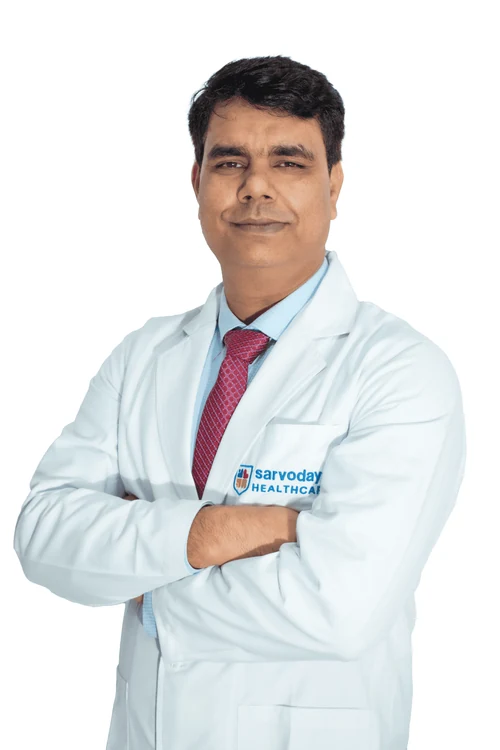
Why consult Dr. Naresh Panwar
- MIS-TLIF cases form part of Dr. Naresh Panwar's published case imaging
- Minimally Invasive Spine Surgery is a listed specialisation on his Sarvodaya Hospital profile
- Trained in general surgery (MS, KGMU Lucknow) and neurosurgery (MCh, SMS Medical College Jaipur)
- Consults at Sarvodaya Hospital, Sector 8 — convenient for NIT, Ballabhgarh and Greater Faridabad
Questions to ask your surgeon
Write these down and bring them to your appointment.
- What type and grade of spondylolisthesis do I have?
- Is my spine unstable on bending X-rays?
- Do I need fusion, or only decompression?
- Am I a suitable candidate for MIS-TLIF?
- How will you check that the fusion has become solid?
Frequently asked questions
Kya kamar ki haddi khisakne ka ilaaj bina operation ho sakta hai?
Often, yes. Many people with a low-grade slip do well with exercises, physiotherapy, weight control and medicines for flare-ups. Surgery is considered for persistent disabling pain, nerve weakness or instability.
Will the vertebra go back into place after surgery?
Partial correction is sometimes achieved, but the main aims are freeing the nerves and stopping abnormal movement. In most low-grade slips, a solid fusion matters more than perfect alignment.
Is MIS-TLIF suitable for everyone?
No. It suits many one- or two-level slips, but severe deformity, high-grade slips or some revisions may need open surgery. Read more about minimally invasive spine surgery.
My son bowls fast in cricket and has back pain — could it be a pars fracture?
It is possible, and persistent low back pain in a young fast bowler or gymnast should be checked. Early rest and rehabilitation often allow healing or good function without surgery.
I live in Greater Faridabad — where can I be assessed?
Dr. Naresh Panwar sees spine patients at Sarvodaya Hospital, Sector 8, close to Mathura Road and Escorts Mujesar Metro Station. Bring your X-rays, MRI and reports, and call +91 96608 88640 to confirm consultation timings.
Related care & reading
Appointments
Your brain and spine health deserve a carefully considered plan.
Request a consultation with Dr. Naresh Panwar at Sarvodaya Hospital, Sector 8, Faridabad. Bring your MRI or CT scans and reports, and the care team will help you prepare.