Spine · Skull–Spine Junction
Craniovertebral Junction (CVJ) Anomalies — Treatment in Faridabad
The narrow meeting point of skull and spine protects the brainstem. When it is malformed or unstable, careful evaluation matters.
सिर और गर्दन के जोड़ में जन्म से या चोट के बाद आई खराबी से हाथ-पैरों में कमज़ोरी, संतुलन बिगड़ना या निगलने में दिक्कत हो सकती है। जाँच के बाद ही तय होता है कि निगरानी, दवा या ऑपरेशन उचित है।
Understanding Craniovertebral Junction
The craniovertebral junction (CVJ) is where the base of the skull meets the first two neck bones — the atlas (C1) and the axis (C2). Through this small opening passes the brainstem, which controls breathing, swallowing and every movement of the arms and legs. Because space here is so tight, even a small bony malformation or instability can press on vital structures.
Common CVJ problems include basilar invagination, where the tip of C2 pushes upward into the skull base; atlantoaxial instability, where the C1–C2 joint becomes loose; and Chiari malformation, where the lowest part of the cerebellum sits below the skull opening, sometimes with a fluid cavity (syrinx) in the cord. Many are present from birth, yet symptoms may appear only in adulthood, sometimes after a minor neck jerk.
Craniovertebral junction anomalies are listed among Dr. Naresh Panwar's areas of expertise, and the region overlaps with skull base surgery. Patients from Ballabhgarh and Palwal sometimes arrive after years of neck pain treated as simple cervical spondylosis. The right examination and scans clarify the true cause, and a related condition such as hydrocephalus may also need to be checked carefully.
Common symptoms
Symptoms vary from person to person. Having one of these does not mean you have this condition.
Pain at the skull base worsening with coughing, sneezing or straining — typical of Chiari.
Gradually increasing weakness or stiffness from upper cord pressure.
Dropping objects, difficulty buttoning or unsteady walking.
Choking on liquids or a hoarse voice when the brainstem is affected.
Loss of pain and temperature sense, often from a syrinx.
Possible causes & risk factors
Bones of the skull base, C1 and C2 may form abnormally before birth.
A developmental difference with the cerebellum extending into the spinal canal.
Both are linked with looseness of the C1–C2 joint.
Trauma or infections such as tuberculosis can damage this region.
When to seek help
Book a routine consultation
- Back-of-head headaches brought on by coughing or straining.
- An MRI mentioning 'Chiari', 'basilar invagination' or 'atlantoaxial'.
- Gradually increasing hand clumsiness or unsteady walking.
Seek emergency care
- Sudden weakness of arms and legs after a fall or neck jerk.
- Difficulty breathing, choking or sudden swallowing change.
- Rapid loss of balance or new loss of bladder control. Go to the nearest emergency department or call 112, keeping the neck still.
How it is diagnosed
Shows brainstem and cord pressure, cerebellar position and any syrinx.
Maps bone anatomy and reveals instability when the neck bends.
Shows the vertebral arteries, which run close to where screws may go.
Available treatment options
Treatment is chosen after examining you and studying your scans. Many people do well without an operation.
An incidental Chiari or minor anomaly without symptoms may only need periodic review.
Pain medicines, avoiding neck manipulation and sometimes a collar while assessment continues.
For symptomatic Chiari, bone at the back of the skull opening is removed to relieve crowding.
Screws, rods and bone graft realign and fuse unstable joints, relieving brainstem and cord pressure.
In selected cases bone pressing from the front may be removed via the mouth or nose, as decided by the treating team.
When neurosurgery may be recommended
- Symptoms of brainstem or upper cord compression.
- Instability confirmed on dynamic imaging.
- An enlarging syrinx or disabling Chiari symptoms.
- Worsening neurological function, breathing or swallowing.
Procedure overview
A simplified outline. The exact steps depend on your scans and the approach chosen.
- 3D planningCT, MRI and artery imaging plan a safe route for decompression and screws.
- Careful anaesthesia and positioningThe neck is handled gently and the head held still in a frame.
- Realignment and fixationJoints are realigned where possible and held with screws, rods and graft.
- Close monitoringBreathing, swallowing and limb strength are watched closely afterwards.
Potential benefits, risks & limitations
Potential benefits
- Relief of brainstem and cord pressure, which may halt decline.
- Improvement in headache, balance or strength in many patients.
- A stable junction, less vulnerable to minor neck injuries.
Possible risks
- Rare but serious vertebral artery, cord or brainstem injury.
- Spinal fluid leak and infection.
- Swallowing or breathing difficulty after surgery.
- Reduced head rotation after C1–C2 fusion, or implant failure.
CVJ surgery mainly aims to stop further damage; long-standing nerve damage may improve only partly. Fusing C1 and C2 reduces head rotation, which most people adapt to.
Recovery & follow-up
Recovery is gradual. Some patients wear a collar while bones fuse, and physiotherapy targets balance, hand function and walking. Follow-up CT checks fusion and implant position.
Headache may improve early, while strength and sensation can take many months to recover and may be incomplete. Families should learn the warning signs that need urgent review.
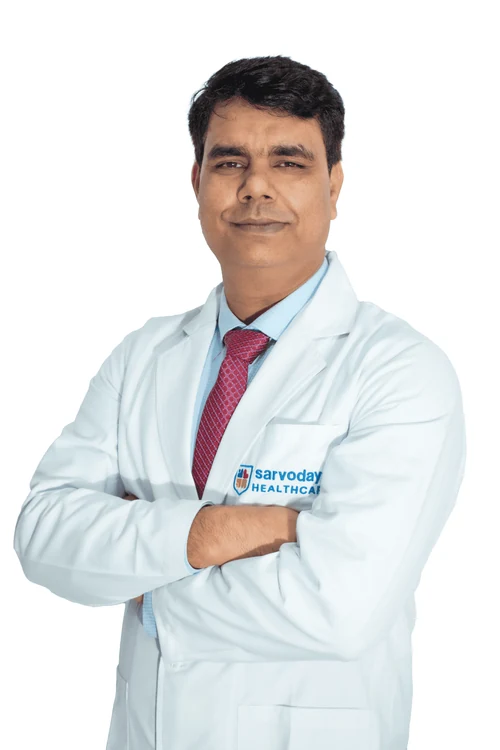
Why consult Dr. Naresh Panwar
- Craniovertebral junction anomalies are listed among his areas of expertise.
- Skull Base Surgery and Neuro-endoscopy are listed specialisations; Fellowship in Neuroendoscopy.
- MCh (Neurosurgery), SMS Medical College, Jaipur; Senior Resident in Neurosurgery, RMLIMS, Lucknow.
- Senior Consultant & Head Unit (II) – Neurosurgery, Sarvodaya Hospital, Faridabad.
Questions to ask your surgeon
Write these down and bring them to your appointment.
- Which CVJ problem do I have?
- Is my neck unstable, or is it only crowding?
- Does waiting carry risk?
- How will neck movement be affected after surgery?
- Should my child or family members be checked?
Frequently asked questions
My MRI shows Chiari malformation, but I feel fine. Do I need surgery?
Not necessarily. Chiari is sometimes found by chance and may never cause trouble. Surgery is usually considered only with clear symptoms or a syrinx.
Kya gardan aur sir ke jod ki yeh bimari janm se hoti hai?
Many CVJ anomalies are present from birth, though symptoms may appear only in adulthood. Others follow injury, rheumatoid arthritis or infection.
Will I be able to turn my neck after C1–C2 fusion?
Head rotation will be reduced, because much of it happens at C1–C2. Most people adapt by moving the rest of the neck and body; nodding is less affected.
Is neck massage or chiropractic adjustment safe with a CVJ problem?
Forceful manipulation is generally avoided when there is CVJ instability, as it may risk cord injury. Discuss any therapy with your neurosurgeon first.
Can a CVJ anomaly be evaluated in Faridabad?
Yes, at Sarvodaya Hospital near Escorts Mujesar Metro Station. Bring MRI and CT films and call +91 96608 88640 to confirm consultation timings.
Related care & reading
Appointments
Your brain and spine health deserve a carefully considered plan.
Request a consultation with Dr. Naresh Panwar at Sarvodaya Hospital, Sector 8, Faridabad. Bring your MRI or CT scans and reports, and the care team will help you prepare.