Brain · Functional Neurosurgery
Epilepsy Surgery in Faridabad
Most people with epilepsy do well on medicines from their neurologist. For those whose seizures continue despite trying them properly, surgery may deserve a careful look.
ज़्यादातर मिर्गी के मरीज़ दवाओं से ठीक रहते हैं। अगर दो सही दवाएं ठीक से लेने के बाद भी दौरे बंद न हों, तो न्यूरोलॉजिस्ट के साथ मिलकर सर्जरी की जांच पर विचार किया जा सकता है।
Understanding Epilepsy Surgery
Epilepsy is managed first by a neurologist or epileptologist, and most patients gain control with the right medicine at the right dose. Surgery is never the first step. It becomes a question only when epilepsy is drug-resistant — usually defined as seizures continuing after two appropriate, well-tolerated anti-seizure medicines have been tried properly, alone or together.
If you are unsure whom to see first, our guide on neurosurgeon vs neurologist explains the roles. In drug-resistant epilepsy they work as one team: the neurologist pinpoints where seizures begin, and the neurosurgeon assesses whether that area can be treated safely. Sometimes the cause is visible on MRI — a scar, a cavernoma, a developmental abnormality or a low-grade tumour.
Epilepsy surgery is listed among Dr. Naresh Panwar's areas of work at Sarvodaya Hospital, Faridabad. Families in Faridabad and Palwal sometimes live with frequent seizures for years, believing nothing more can be done. An evaluation does not commit anyone to an operation.
Common symptoms
Symptoms vary from person to person. Having one of these does not mean you have this condition.
Fits continue even though medicines are taken regularly at advised doses.
Staring spells, lip-smacking or fumbling, sometimes preceded by a rising feeling in the stomach.
Drop attacks or convulsions causing fractures, burns or head injuries.
Drowsiness, dizziness, mood or memory problems from high doses.
Fits during sleep, sometimes with tongue biting.
Missed school or work, inability to drive, and social isolation.
Possible causes & risk factors
Scarring of the inner temporal lobe, a common cause of drug-resistant focal seizures in adults.
A patch of brain that developed abnormally before birth.
Low-grade tumours and cavernomas can irritate the brain surface.
Scars from head injury, stroke or infections such as neurocysticercosis.
Some epilepsies have no single focus, which makes resective surgery unsuitable.
When to seek help
Book a routine consultation
- Seizures continuing after two appropriate medicines — ask your neurologist about surgical evaluation
- An MRI showing a lesion that may be causing seizures
- Side effects limiting how much medicine can be given
- A child whose seizures are affecting learning or development
Seek emergency care
- A seizure lasting more than five minutes — call 112 or go to the nearest emergency department
- Repeated seizures without waking up in between
- A first seizure in an adult, especially with headache or weakness
- A seizure with a significant head injury, breathing difficulty or near-drowning
How it is diagnosed
Seizures are recorded on video while brain waves are measured, usually over several days, to see exactly where they begin.
Thin-slice sequences designed to reveal subtle scars or developmental changes.
Show areas of altered activity when MRI looks normal or results disagree.
Assess memory and language to predict the effect of surgery.
Neurologist, neurosurgeon and radiologist review results together.
Available treatment options
Treatment is chosen after examining you and studying your scans. Many people do well without an operation.
Your neurologist may adjust, switch or combine medicines and confirm the events are truly epileptic.
Regular sleep, avoiding alcohol and, in selected children, a supervised ketogenic diet can reduce seizures.
Removing the seizure-producing area, such as part of the temporal lobe or a lesion, when this can be done without harming vital functions.
In some severe childhood epilepsies, cutting seizure-spreading pathways may reduce dangerous falls.
A small pacemaker-like device under the chest skin stimulates a nerve in the neck. It rarely stops seizures fully but may reduce their frequency or severity when resection is not possible.
When neurosurgery may be recommended
- Drug-resistant epilepsy confirmed by a neurologist
- Seizures arising from one area that can be safely removed
- A clear MRI lesion that matches the seizure recordings
- VNS considered when no removable focus exists
Procedure overview
A simplified outline. The exact steps depend on your scans and the approach chosen.
- Neurologist referralEvaluation begins with the treating neurologist confirming drug resistance.
- Pre-surgical workupVideo-EEG, MRI, PET and neuropsychology aim to localise the seizure focus.
- Team decisionOptions, including not operating, are discussed openly with the family.
- Surgery and follow-upSurgery is done under general anaesthesia; medicines usually continue and are adjusted only by the neurologist.
Potential benefits, risks & limitations
Potential benefits
- Possible reduction in seizures, and freedom from them for some
- Possibly fewer medicines or lower doses over time
- Greater safety and independence for many patients
Possible risks
- Memory or language changes, depending on the area treated
- Partial loss of side vision after temporal lobe surgery
- Weakness or numbness
- Infection and bleeding
- Seizures continuing or returning
- Hoarseness or cough during VNS stimulation
Not everyone with drug-resistant epilepsy is a surgical candidate, and surgery cannot promise freedom from seizures.
Recovery & follow-up
Hospital stay after resective surgery is usually several days, and tiredness and headache are common early on. Driving should wait until your neurologist confirms it is safe.
Keep a seizure diary and attend reviews with both neurologist and neurosurgeon. Our article on when epilepsy surgery is considered is a helpful read for families.
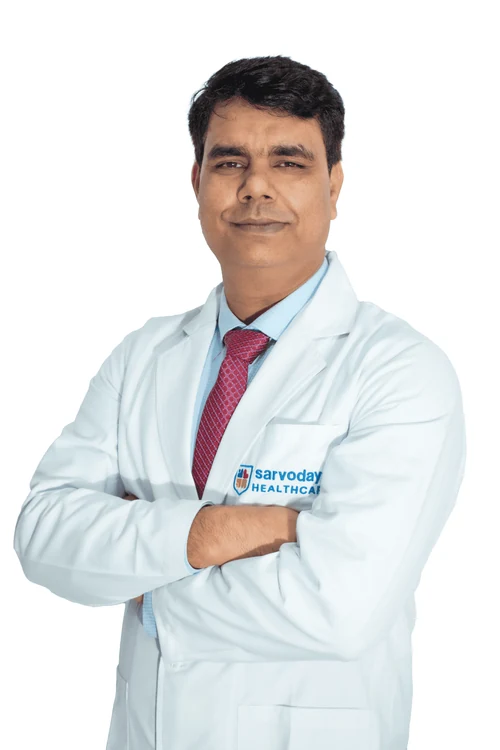
Why consult Dr. Naresh Panwar
- Epilepsy surgery appears in his list of treated conditions on the Sarvodaya Hospital profile
- Surgical training at King George's Medical University, Lucknow, and neurosurgical training at SMS Medical College, Jaipur
- Has authored papers in national and international journals, including World Neurosurgery (2019)
- Member of the Neurological Society of India and the European Association of Neurosurgical Societies
Questions to ask your surgeon
Write these down and bring them to your appointment.
- Has my epilepsy been confirmed as drug-resistant?
- Where do my seizures start, and do all tests agree?
- What could happen to my memory or speech?
- If resection is not possible, is VNS an option?
- Will my medicines change after surgery?
Frequently asked questions
Should I see a neurologist or a neurosurgeon for epilepsy?
Start with a neurologist, because most epilepsy is controlled with medicines. A neurosurgeon becomes involved when seizures persist despite proper trials and the neurologist feels surgical evaluation is worthwhile.
Kya mirgi ka operation safe hota hai?
Har operation mein kuch risk hota hai. Epilepsy surgery tabhi socha jata hai jab daure dawaiyon se control na hon aur jaanch se saaf pata chale ki daure kahan se shuru hote hain. Faisla neurologist aur neurosurgeon milkar karte hain.
Is epilepsy surgery only for adults?
No. Children with drug-resistant epilepsy are sometimes evaluated early, led by a paediatric neurologist, because ongoing seizures can affect development.
We are from Ballabhgarh. How do we start the evaluation?
Ask your neurologist for a referral summary, and bring EEG reports, MRI films and a full medicine history to a consultation at Sarvodaya Hospital, Sector 8, Faridabad. Call +91 96608 88640 to confirm consultation timings.
Does VNS replace medicines?
No. VNS is an add-on therapy that may reduce how often or how strongly seizures occur. Most patients continue their medicines.
Related care & reading
Appointments
Your brain and spine health deserve a carefully considered plan.
Request a consultation with Dr. Naresh Panwar at Sarvodaya Hospital, Sector 8, Faridabad. Bring your MRI or CT scans and reports, and the care team will help you prepare.