Skull Base · Pituitary
Pituitary Tumour Treatment in Faridabad
Pituitary tumours touch vision, hormones and everyday wellbeing. Good care brings neurosurgery, endocrinology and eye specialists together around one plan.
पिट्यूटरी ट्यूमर ज़्यादातर कैंसर नहीं होते, पर ये आँखों की रोशनी और हार्मोन पर असर डाल सकते हैं। कुछ ट्यूमर दवा से नियंत्रित होते हैं और कुछ में नाक के रास्ते एंडोस्कोपिक सर्जरी की जाती है।
Understanding Pituitary Tumour
The pituitary is a pea-sized gland in a bony pocket at the base of the skull, behind the nose and just below the nerves that carry vision. Often called the 'master gland', it controls growth, thyroid, adrenal, reproductive and water-balance hormones. Most pituitary tumours are pituitary adenomas: benign growths that are not cancer, but cause real problems because of where they sit.
Some adenomas make excess hormone (functioning tumours), causing acromegaly, Cushing's disease or high prolactin. Others are non-functioning and grow large enough to press on the optic nerves, narrowing side vision so gradually that people only notice after bumping into doorframes or a near-miss on the road.
Treatment is not always surgical. A prolactin-secreting tumour (prolactinoma) is usually treated first with tablets. When surgery is needed, the common route is the endoscopic endonasal approach, through the nose, with no cut on the face or scalp. It is part of skull base surgery. Patients from Faridabad, NIT and Ballabhgarh are assessed with endocrine and eye specialists.
Common symptoms
Symptoms vary from person to person. Having one of these does not mean you have this condition.
Loss of outer vision in both eyes is a classic sign.
Often in the forehead or behind the eyes.
Irregular periods or milky breast discharge may point to high prolactin.
Hormonal effects in men are common and often overlooked.
May suggest excess growth hormone (acromegaly).
Possible signs of excess cortisol (Cushing's disease).
Possible causes & risk factors
Most adenomas arise without any known cause.
Rarely, conditions such as MEN1 cause pituitary tumours.
Rathke's cleft cysts and craniopharyngiomas occur here too and are evaluated similarly.
Adenomas appear at all adult ages, often in mid-life.
When to seek help
Book a routine consultation
- Gradual narrowing of side vision or frequent bumping into things
- Blood tests showing high prolactin, growth hormone or cortisol
- A pituitary lesion found on an MRI done for something else
- Irregular periods, infertility or low libido without clear cause
Seek emergency care
- Sudden severe headache with sudden vision loss or double vision (possible pituitary apoplexy)
- Severe vomiting, low blood pressure or collapse in someone with a known pituitary tumour: call 112
- Clear watery drip from the nose after pituitary surgery: seek urgent care
How it is diagnosed
Thin-slice scans show tumour size and its relation to the optic nerves and carotid arteries.
Show whether the tumour makes excess hormone and whether normal pituitary output has dropped.
Maps any side vision loss and provides a baseline.
Shows bony anatomy for planning the route through the nose.
Available treatment options
Treatment is chosen after examining you and studying your scans. Many people do well without an operation.
Small non-functioning tumours with normal vision are often watched with periodic MRI and hormone tests.
Prolactinomas commonly shrink with tablets such as cabergoline; some other functioning tumours are also treated with medicines.
Missing hormones such as thyroid or cortisol are replaced by the endocrinologist.
The tumour is removed through the nostril with a thin endoscope, giving a wide view without an external cut. Read about neuroendoscopy.
May be considered for leftover or returning tumour, planned by the radiation oncology team.
When neurosurgery may be recommended
- Pressure on the optic nerves affecting vision
- Pituitary apoplexy (sudden bleeding into the tumour) with vision loss
- Hormone-secreting tumours such as acromegaly or Cushing's disease
- Prolactinoma not responding to, or not tolerating, tablets
- Steady growth on follow-up MRI
Procedure overview
A simplified outline. The exact steps depend on your scans and the approach chosen.
- Joint planningHormone results, vision tests and MRI are reviewed together before surgery.
- Endonasal accessUnder general anaesthesia, the endoscope passes through the nostril to the sphenoid sinus.
- Tumour removalThe tumour is removed piece by piece while protecting the normal gland, optic nerves and carotid arteries.
- Skull base repairThe opening is sealed, sometimes with a graft, to prevent fluid leak.
Potential benefits, risks & limitations
Potential benefits
- Vision often improves once pressure on the optic nerves is relieved, though this varies
- Hormone excess may come under control
- No visible scar on the face or scalp
- Usually a shorter hospital stay than open skull surgery
Possible risks
- Cerebrospinal fluid (CSF) leak through the nose
- Temporary or lasting hormone deficiency
- Diabetes insipidus: excess urine and thirst, often temporary
- Nasal crusting or bleeding
- Rarely, injury to vision or the carotid artery
Tumours that grow sideways into the cavernous sinus, around the carotid artery, often cannot be fully removed safely, and some patients need medicines or radiotherapy afterwards.
Recovery & follow-up
Many patients sit up and eat the same or next day. Nasal stuffiness is common for a few weeks, and hard nose-blowing, bending and straining are avoided for a while. Fluid intake and urine output are watched closely early on.
Hormone tests are repeated after surgery and at follow-up, and some people need long-term hormone tablets. Vision is re-checked and a follow-up MRI is planned some months later, with ongoing care shared with your endocrinologist.
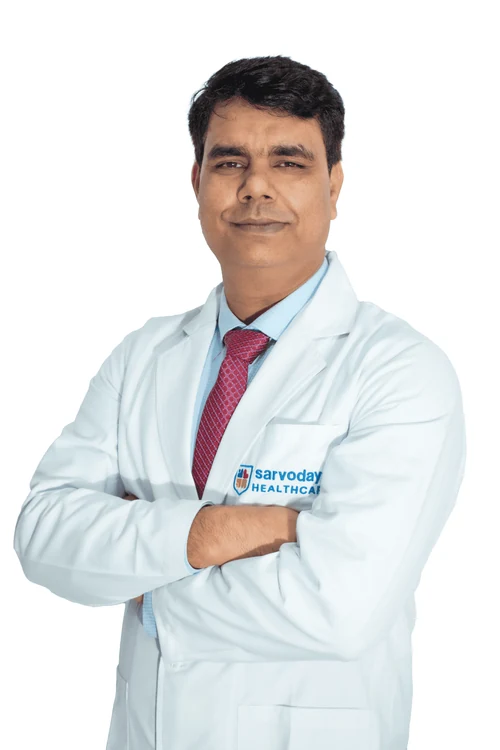
Why consult Dr. Naresh Panwar
- Fellowship in Neuroendoscopy
- Skull Base Surgery and Neuro-endoscopy are listed specialisations on his Sarvodaya Hospital profile
- Senior Consultant & Head Unit (II) – Neurosurgery, Sarvodaya Hospital, Sector 8, Faridabad
- Member of the Neurological Society of India (NSI)
Questions to ask your surgeon
Write these down and bring them to your appointment.
- Is my tumour functioning or non-functioning?
- Can medicines be tried first?
- How much is my vision affected, and can it improve?
- Will I need hormone tablets after surgery?
- How will a CSF leak be prevented and managed?
Frequently asked questions
Is pituitary surgery done through the nose?
In most cases, yes. The endoscopic endonasal approach reaches the pituitary through the nostril, so there is no cut on the face or skull. Very large or unusually shaped tumours occasionally need a different or combined approach.
Do all pituitary tumours need surgery?
No. Prolactinomas usually respond to tablets, and small non-functioning tumours with normal vision are often only monitored. Surgery is considered when vision is threatened, hormones are uncontrolled or the tumour grows.
Will my eyesight come back after surgery?
Many patients notice better side vision once pressure is relieved, but it depends on how long and how badly the nerves were compressed. Earlier evaluation gives the nerves a better chance.
Pituitary tumour mein naak se operation safe hai kya?
Endoscopic naak ke raaste operation ek sthapit tareeka hai, lekin har surgery ki tarah iske bhi risks hain, jaise naak se paani (CSF) aana ya hormone ki kami. Doctor aapke tumour ke hisaab se risks samjhaate hain.
Can I get vision and hormone tests in Faridabad before seeing the surgeon?
Yes, both are widely available in Faridabad. Bring the results with your pituitary MRI to Sarvodaya Hospital, Sector 8, and call +91 96608 88640 to confirm consultation timings.
Related care & reading
Appointments
Your brain and spine health deserve a carefully considered plan.
Request a consultation with Dr. Naresh Panwar at Sarvodaya Hospital, Sector 8, Faridabad. Bring your MRI or CT scans and reports, and the care team will help you prepare.