Brain · Facial Nerve Pain
Trigeminal Neuralgia & MVD Surgery in Faridabad
Sudden, electric-shock pain in the face can make eating, talking or brushing teeth frightening. Effective options exist, and most begin with medicines.
इसमें चेहरे पर बिजली के झटके जैसा तेज़ दर्द होता है, जो खाने, बोलने या ब्रश करने से शुरू हो सकता है। इलाज आमतौर पर दवाओं से शुरू होता है; दवा से आराम न मिलने पर MVD सर्जरी जैसे विकल्पों पर विचार किया जाता है।
Understanding Trigeminal Neuralgia & MVD
The trigeminal nerve carries feeling from the face to the brain. In trigeminal neuralgia, it fires brief, severe, shock-like jolts of pain, usually on one side of the cheek, jaw, teeth or forehead. Light triggers — a breeze, chewing, shaving, washing the face — can set off an attack. Many patients first visit a dentist, and some have healthy teeth removed before the real cause is recognised.
The commonest cause is a blood vessel pressing on the nerve where it leaves the brainstem. A related condition, hemifacial spasm, involves the facial nerve and causes repeated twitching on one side of the face, usually without pain and often starting around the eye. Both are treated in the region behind the ear that falls within skull base surgery.
Treatment usually starts with medicines such as carbamazepine or related drugs. When they stop working or cause intolerable side effects, microvascular decompression (MVD) — gently moving the vessel off the nerve — may be considered. Sarvodaya Hospital has published a patient's video story of an MVD performed by Dr. Naresh Panwar's team after six years of facial pain.
Common symptoms
Symptoms vary from person to person. Having one of these does not mean you have this condition.
Stabbing jolts lasting seconds, often in rapid bursts.
Touching a spot near the nose, lip or cheek provokes pain.
Eating, talking, brushing teeth or cold wind can set off attacks.
Weeks or months of relief before attacks return.
In hemifacial spasm, contractions begin near the eye and may spread to the cheek and mouth.
Some patients lose weight avoiding food.
Possible causes & risk factors
An artery or vein loops against the nerve at the brainstem, wearing its insulating layer.
Can cause facial neuralgia, especially in younger patients, and needs neurology input.
Rarely, a growth near the nerve causes similar pain, which is why an MRI matters.
Most often begins after middle age, though it can start earlier.
When to seek help
Book a routine consultation
- Recurrent shock-like facial pain not explained by a dental problem
- Medicines that have stopped working or cause drowsiness and imbalance
- Gradually increasing twitching on one side of the face
- A second opinion before dental extraction for unexplained facial pain
Seek emergency care
- Facial numbness with sudden weakness, slurred speech or vision loss — go to the nearest emergency department or call 112
- Sudden facial droop with inability to close one eye
- Skin rash, blistering, fever or mouth ulcers after starting carbamazepine — seek urgent medical care
- Severe headache with vomiting or confusion
How it is diagnosed
The pattern of pain is often enough for diagnosis; a clear description of triggers helps most.
Thin-slice images show vessel contact and rule out tumours or multiple sclerosis.
Checks facial sensation, jaw strength and other cranial nerves.
Blood count, liver and sodium levels may be monitored during treatment.
Available treatment options
Treatment is chosen after examining you and studying your scans. Many people do well without an operation.
Carbamazepine, oxcarbazepine and similar medicines help many people, especially early on. Doses should only be changed by your doctor.
Injections every few months reduce twitching for many patients.
Through a small opening behind the ear, the offending vessel is moved away and a soft cushion placed between it and the nerve, preserving the nerve itself.
Radiofrequency, glycerol or balloon procedures deliberately weaken part of the nerve to reduce pain, often for older or medically unfit patients.
Radiosurgery is a non-incision option in selected patients; relief is delayed and some numbness may follow.
When neurosurgery may be recommended
- Pain not controlled by adequate doses of medicine
- Side effects such as drowsiness, confusion or imbalance limiting medicine use
- MRI showing a vessel in contact with the nerve
- Troublesome hemifacial spasm despite botulinum injections
Procedure overview
A simplified outline. The exact steps depend on your scans and the approach chosen.
- MRI reviewConfirms vessel contact and excludes other causes.
- General anaesthesiaThe patient is fully asleep throughout.
- Opening behind the earA coin-sized window gives microscope or endoscope access to the nerve.
- DecompressionThe vessel is lifted off the nerve and a Teflon-type cushion is placed between them.
Potential benefits, risks & limitations
Potential benefits
- Can relieve pain while preserving facial sensation
- May allow medicines to be reduced or stopped
- Treats the cause in vessel-related cases
Possible risks
- Hearing loss on the operated side
- CSF leak from the wound
- Facial numbness or weakness
- Bleeding or stroke, which are uncommon
- Pain returning in future
MVD does not help when no vessel contact is present, and pain can return years later. Needle and radiation procedures trade some facial numbness for pain relief.
Recovery & follow-up
Some patients notice relief soon after MVD, while in others it improves gradually. Medicines are reduced step by step under guidance, never stopped all at once.
Patients from Ballabhgarh, NIT Faridabad and Palwal can arrange wound checks and follow-up at Sarvodaya Hospital, Sector 8. Report any clear fluid from the wound or nose, fever or hearing change promptly.
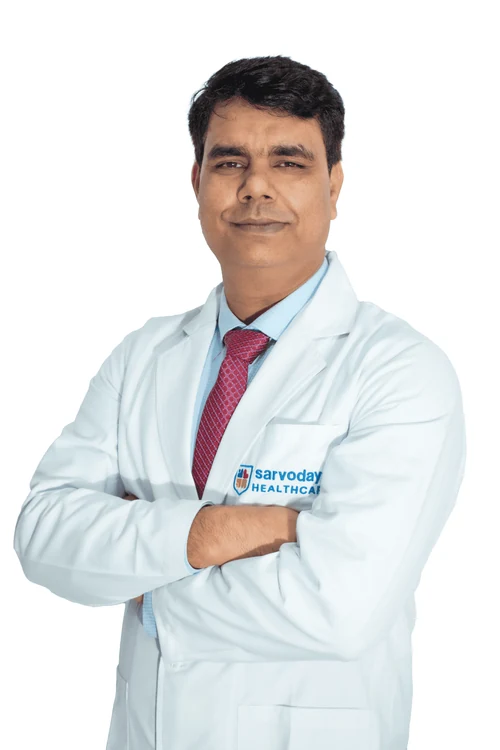
Why consult Dr. Naresh Panwar
- Sarvodaya Hospital has published a patient video story of MVD for trigeminal neuralgia performed by his team
- Skull base surgery, the region where MVD is performed, is listed among his specialisations
- MCh Neurosurgery from SMS Medical College, Jaipur, with a Fellowship in Neuroendoscopy
- Senior Consultant & Head Unit (II) – Neurosurgery, Sarvodaya Hospital, Faridabad
Questions to ask your surgeon
Write these down and bring them to your appointment.
- Is my pain typical trigeminal neuralgia or another type of facial pain?
- Does my MRI show a vessel touching the nerve?
- Am I suitable for MVD, or would a needle procedure suit me more?
- What is the risk to hearing on that side?
- How will my medicines be reduced after surgery?
Frequently asked questions
Is this a dental problem?
Trigeminal neuralgia often feels like toothache, but the teeth are usually healthy. If dental treatment has not helped, a neurological evaluation is worthwhile before further extractions.
Chehre ki nas ke dard mein kya operation zaroori hai?
Nahi. Zyadatar mareez pehle dawaiyon se theek rehte hain. Operation tab socha jata hai jab dawa kaam na kare ya uske side effects bardasht na hon.
Can trigeminal neuralgia be evaluated in Faridabad?
Yes. Medicines and surgical options including MVD can be discussed at Sarvodaya Hospital, Sector 8, Faridabad. Bring your MRI and medicine history, and book an appointment or call +91 96608 88640 to confirm timings.
What is hemifacial spasm?
It is involuntary twitching of one side of the face caused by irritation of the facial nerve, often by a blood vessel. Botulinum injections help many patients, and MVD is an option when they do not.
Will the pain come back?
It can. Some people stay pain-free for many years, while others need further medicines or procedures.
Related care & reading
Appointments
Your brain and spine health deserve a carefully considered plan.
Request a consultation with Dr. Naresh Panwar at Sarvodaya Hospital, Sector 8, Faridabad. Bring your MRI or CT scans and reports, and the care team will help you prepare.