Spine · Walking & Leg Pain
Lumbar Spinal Stenosis Treatment in Faridabad
Legs that turn heavy a few minutes into a walk may point to a narrowed spinal canal — a treatable problem.
स्पाइनल कैनाल स्टेनोसिस में थोड़ी दूर चलते ही पैरों में दर्द, भारीपन या सुन्नपन होता है जो बैठने या आगे झुकने से आराम पाता है। व्यायाम, दवा और फिज़ियोथेरेपी से कई मरीज़ों को राहत मिलती है; ज़रूरत पड़ने पर नसों का दबाव हटाने वाली सर्जरी पर विचार किया जाता है।
Understanding Lumbar Spinal Stenosis
Many older adults in Faridabad describe the same story: a few hundred metres into a walk, their legs turn heavy, numb or painful, and they must stop and sit. After a short rest they carry on — until it happens again. This is neurogenic claudication, usually caused by lumbar spinal stenosis: bulging discs, enlarged facet joints and a thickened ligament gradually narrow the canal and crowd the nerves to the legs.
Standing upright narrows the canal further, while bending forward opens it slightly — so many patients walk more easily leaning on a shopping trolley or stick, the shopping-cart sign. Not all walking pain is spinal, though. Narrowed leg arteries, common in smokers and people with diabetes, cause similar cramps that usually ease just by standing still, and diabetic nerve damage can cause burning feet. Careful examination separates these before treatment is planned.
Common symptoms
Symptoms vary from person to person. Having one of these does not mean you have this condition.
Heaviness, cramping or aching in the buttocks, thighs or calves that builds with walking or standing.
Symptoms settle within minutes of sitting down or leaning forward.
Pins and needles in both legs or feet, often worse towards the end of a walk.
The distance you can manage before stopping reduces over months.
Legs that feel like giving way, or a tendency to stumble, in advanced cases.
Possible causes & risk factors
Disc bulging, facet joint enlargement and ligament thickening, most often after 50.
A vertebra slipping forward adds to the narrowing — see spondylolisthesis.
Some people are born with a smaller canal and develop symptoms earlier.
Scar tissue or healed fractures may narrow the canal.
When to seek help
Book a routine consultation
- Walking distance limited by leg pain or heaviness
- Needing to sit repeatedly while shopping or at a temple or wedding
- Numbness in both feet
Seek emergency care
- New loss of bladder or bowel control, or saddle numbness
- Sudden severe weakness in one or both legs
- Back pain with fever or unexplained weight loss
- With these signs, go to the nearest emergency department or call 112
How it is diagnosed
Checking leg pulses, reflexes and sensation helps separate spinal causes from artery disease and neuropathy.
Shows how tight the canal is at each level and which nerves are crowded — see our stenosis guide.
Standing bending X-rays reveal slippage; an arterial Doppler or nerve conduction study is added if vascular disease or neuropathy is suspected.
Available treatment options
Treatment is chosen after examining you and studying your scans. Many people do well without an operation.
A stationary cycle or walking with a slight forward lean can improve walking tolerance, adapted by a physiotherapist to your joints and balance.
Pain relievers and nerve-pain medicines, chosen carefully in older patients with kidney, heart or stomach issues; losing extra weight reduces spinal load.
In selected patients, an injection may give temporary relief and help them stay active, though it does not widen the canal.
Bone and thickened ligament pressing on the nerves are removed to create room, where suitable through minimally invasive muscle-sparing approaches.
If the spine is unstable or slipping, screws and rods are added so the segment heals as one solid unit.
When neurosurgery may be recommended
- Walking distance has shrunk enough to restrict daily life
- Symptoms persist despite a fair trial of exercise and medicines
- Leg weakness, balance problems, or bladder and bowel symptoms (an emergency)
- MRI narrowing that matches the symptoms, with general health that allows safe anaesthesia
Procedure overview
A simplified outline. The exact steps depend on your scans and the approach chosen.
- Pre-operative assessmentHeart, lung, diabetes and blood-thinner review with the anaesthesia team, as many stenosis patients are older.
- Anaesthesia and positioningUnder general anaesthesia you lie face down on a padded frame.
- Removing the pressureThickened ligament and overgrown bone are removed under magnification; screws and rods are added only if instability is present.
- Getting up earlyMany patients are helped to walk within a day, with physiotherapy starting in hospital.
Potential benefits, risks & limitations
Potential benefits
- Often improves leg pain and walking distance
- May reduce numbness and heaviness in the legs
- Can help older adults regain independence in daily activities
Possible risks
- Dural tear causing a spinal fluid leak, usually repaired during surgery
- Infection, bleeding or blood clots in the legs
- Nerve injury, rarely causing new weakness
- Medical complications related to age, heart or lung conditions
Decompression relieves leg symptoms more reliably than long-standing back ache. Long-standing numbness may not fully disappear, and other levels can narrow over time.
Recovery & follow-up
Short, frequent walks usually begin soon after surgery and lengthen gradually. Many patients feel their legs are lighter early on, while stamina builds over weeks; older patients may need more time.
Continuing core and leg strengthening, controlling blood sugar and weight, and staying active help protect the spine.
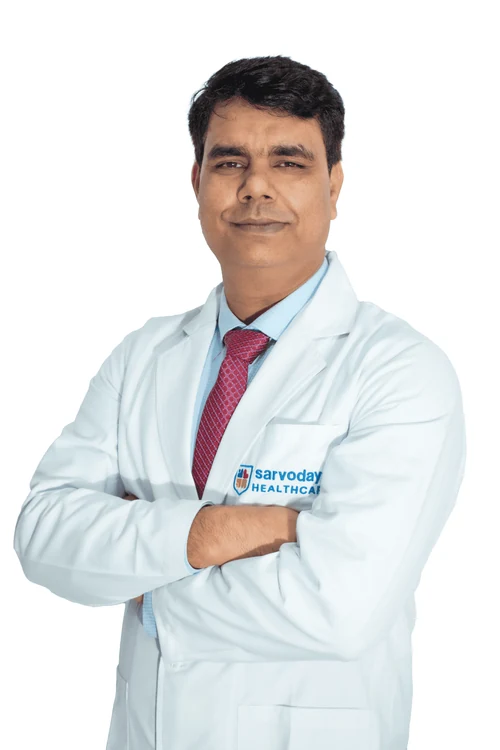
Why consult Dr. Naresh Panwar
- Senior Consultant & Head Unit (II) – Neurosurgery at Sarvodaya Hospital, Sector 8, near Escorts Mujesar Metro
- Minimally Invasive Spine Surgery is one of his officially listed specialisations
- Previous neurosurgical roles at Asian Institute of Medical Sciences, Faridabad, and Medanta Institute of Neurosciences, Lucknow
- Fellowship in Neuroendoscopy alongside MCh (Neurosurgery) training
Questions to ask your surgeon
Write these down and bring them to your appointment.
- How severe is the narrowing, and at how many levels?
- Is my leg pain from the spine, the arteries or diabetes?
- Do I need decompression alone, or fusion as well?
- Can this be done through a minimally invasive approach?
- How will my heart condition, diabetes or blood thinners be managed around surgery?
Frequently asked questions
Chalne par pairon mein dard hota hai, baithne se theek ho jata hai — kya yeh stenosis hai?
It may be. This pattern is typical of spinal canal stenosis, but narrowed leg arteries and diabetic nerve problems can feel similar. Examination and MRI confirm the cause before treatment is chosen.
Am I too old for stenosis surgery?
Age alone does not decide. Fitness for anaesthesia, heart and lung health, and how much the condition limits your life matter more.
Will an injection cure stenosis?
No. An epidural injection may calm inflamed nerves for a period but does not change the bony narrowing. It can help some patients stay active or delay surgery.
Can stenosis cause paralysis?
Complete paralysis is uncommon. Severe compression can, however, cause progressive weakness or, rarely, cauda equina syndrome with bladder and bowel problems — which needs emergency care.
My parents live in Palwal. Do they need to come to Faridabad for evaluation?
Dr. Naresh Panwar consults at Sarvodaya Hospital, Sector 8. The hospital's booking page also lists Sarvodaya Health Clinic, Palwal — please call +91 96608 88640 to confirm Palwal consultation availability and timings.
Related care & reading
Appointments
Your brain and spine health deserve a carefully considered plan.
Request a consultation with Dr. Naresh Panwar at Sarvodaya Hospital, Sector 8, Faridabad. Bring your MRI or CT scans and reports, and the care team will help you prepare.